Thursday, 5 May 2016

A date with pristine Colombo

Here I am in Colombo, discovering the area on foot and tuk-tuk. The absence of high rises in the city, the clear blue sky and fresh air is mesmerizing! And yes, I shouldn't forget to mention, the low density of population and vehicles (for someone coming from Delhi and Guwahati and Saharanpur, this itself is a breath of fresh air). And the city is clean. The houses, streets and buildings are so clean.

So here's a photo essay of my morning today (and as usual, my photographs have not been photoshopped. It's in natural light.). As I walked about, the green landscape kept me company. So did various species of birds who walked or flew alongside, not afraid of the human presence.

This is the BnB where I am staying. It is run by Jay Abeynayake and his wife Ridma. A lovely couple, most friendly and helpful. I found them on airbnb. Anyone planning a trip to Colombo, and looking to stay in the outskirts can get in touch with them. 
They are at 0773429466.

The kitchen area

And that's me getting ready to explore the neighborhood in the morning.

Right outside Jay and Ridma's beautiful BnB.

I walked down to the Pillawa Temple, about 20 mins on foot from where I am staying. This is the road to the temple and it is lined by shops selling flowers to be offered at the temple.

Friendly flower vendors. 

Another one...

This little bridge leads straight to the temple

Pillawa Temple is  mainly this statue of Lord Buddha and the Bodhi tree behind the statue. 

This is the Bodhi Tree. What I have liked about the Sri Lankans is that they pay so much respect to trees and nature. No wonder the city is such a green belt.

See who gave me company on the road...

Another winged friend...

Two's company <3

The Colombo sky

More winged friends on the road


As I walked further down from Pillawa Temple, I came up to this little road where the wall by its side has interesting graffiti.

Soon I reached the Bellanwila Temple. This too is a Buddhist temple like Pillawa.

Devotees

Inside the temple

Beautiful frescoes on the walls and ceilings of the temple


And giant statues of the Buddha in different positions

This is the sleeping Buddha with devotees around him...

Some devotees even mounted on the walls...


so peaceful....

Inside the Bellanwila Temple premises 

"This temple is considered so sacred that there is a long cherished belief that a child who treads the ground under the shade of its scared Bodhi-tree will never fail in life.
Situated in the outskirts of the city of Colombo, in the village of Bellanwila, just three kilometers from the city limits, Bellanwila temple has a long and hallowed history. The great sanctity attached to the temple is due to its sacred Bodhi-tree. There is authorative literary evidence in ancient texts such as the Sinhala Bodhivamsaya which records that this Bodhi-tree is one of the thirty two saplings that sprang from the sacred Bodhi-tree at Anuradhapura planted in the 3rd century B.C.E. The recorded tradition is as follows: There were five twigs in the Bodhi-sapling that was brought from India to Sri Lanka and planted in the Mahameghavana at Anuradhapura. When the sapling had grown into a tree, eight new saplings sprang from its eastern side. These are called the astaphalaruka-Bodhi-trees and they were planted at eight different spots on the Island. From the other four original branches sprang thirty-two additional saplings which were also distributed throughout the Island. One such plant is the sacred Bodhi-tree at Bellanwila." 
Source: Bellanwila Rajamaha Vihara (http://www.bellanwila.org/en/index.php/bellanwila/home)

From Bellanwila, I took a tuk-tuk to the Hotel Mount Lavinia. Here's a photo of me on the rear-view mirror :) and of the tuk-tuk. 

And this is at the Hotel Mount Lavinia, a colonial heritage hotel.

Legend has it that it used to be a British Governor's house. And this Governor had fallen in love with a local woman who was training to be an entertainer. Such was his ardent love and passion for her that he got a secret passage built in the building (which is still there in the hotel) to sneak her in every night. And the way this love story is still connected to the hotel building is so haunting!  


This is at the private beach of Mount Lavinia Hotel. 

Only a few days ago was I telling Nadeem that I wanted to go to a beach. And Colombo happened! Touchwood :)

At the Mount Lavinia Hotel seafood restaurant, built like a shack overlooking the Indian ocean and the beach. I sat there listening to the sea, sipping local Sri Lankan beer (Lion Lager). 


Pretty girls attending a wedding at Mount Lavinia Hotel

Welcoming guests the traditional way at Mount Lavinia Hotel!

The quaint railway station right by the hotel, since the days of the British.

And look at that palm!

This is a photograph of Jay and Ridma's place again. I am in Colombo for one more day. And I sit here thinking how to make it as relaxing and beautiful as today... 

Thursday, 14 April 2016

From Deprivation to Destitution: The story of Mumtaz Begum

Mumtaz Begum 

"I have been asked not to smile at the camera because someone who has been rendered homeless again and again should not look happy," tells me 36 year old Mumtaz Begum. But I ask her to smile for me, and why not, I said, everyone has the right to be happy. So, keep fighting your fight, I told her.  

Mumtaz's family is one of those 383 families in Topsia, Kolkata who were forcibly evicted by the government of West Bengal in 2012 for the construction of a flyover. "The goons were sent to us and they threatened us to leave. They said we will rape your daughters, will set your house on fire. I didn't want to leave initially, but slowly fear took over and I left my home with my family."

The said forced eviction happened on 7 - 12 Nov 2012, when the slum dwellers of about 2,000 people living under Topsia Bridge No 4, near Park Circus Station in Kolkata, looked on as their homes were demolished without prior notice, without any legal procedure. The affected people were mostly from low income group, from scheduled castes, other backward classes, minority Muslim population, and many were from freed/denotified tribe communities. They lived mostly by rickshaw pulling, daily wage labour, begging, rag-picking, etc.    

Mumtaz Begum, leading the fight for adequate compensation in Topsia, Kolkata


 "We now live in Lohapool, near Topsia. There are about a total of 55 jhuggis in Lohapool. We were not allowed to relocate there by the residents. This slum is by the railway line. If you come to my house, you will see that the railway track is just a step away from the threshold of my house. On two occasions, I was almost hit by a train when I stepped out of my jhuggi. It's that close! My husband is an alcoholic and there were a couple of times when he was almost run over by a train, just outside our house!"

"I very recently got my 14 year old daughter married. I wanted her to study and come out of the cycle of poverty that I have been living. But with this relocation to Lohapool by the railway track, and Ghutiarisharif (prostitution den) which is nearby, I feared for her. So I got her married to a guy nearby who will protect her." What does he do, I ask her. He is a rickshaw-puller, she replies.
 
Leading the fight for the basic human right to housing 

"When I was 21 days old, my parents came to Kolkata to save themselves from poverty. We lived on the Sealdah platform and my parents begged for a living. One day my mother met a woman and she said there are people living in jhuggis in Topsia, come with me. My mother paid Rs 400 to the CPM guys and we were given a place to build our jhuggi." Were you given any document, I asked. No, she said. 

"When I was 13 years old, that slum was destroyed by the CPM, for the construction of a flyover. That was the first time we were rendered homeless. I saw children dying under the bulldozers. The police came and beat us up. We organised a campaign but nothing happened. We lost everything then, whatever little we had."

"With this flyover being constructed at Topsia, we were made homeless a second time." And she tells me that there is a fear of being homeless again since there is a railway station being constructed at Lohapool. 


I ask her, what about toilet facilities. None, she says. "We crap on plastic sheets out in the open, by the railway tracks and throw it away in the garbage. We go without bathing for days. I took a bath yesterday at the hotel (in Delhi where she is staying these days) and I felt so good!" 

Mumtaz has been brought to Delhi by Apne Aap Women Worldwide and Housing and Land Rights Network (HLRN) to release the report 'From Deprivation to Destitution: The Impact of Forced Eviction in Topsia, Kolkata.' The report was launched yesterday at the Indian Women's Press Corps in Delhi. She was accompanied by renowned activist Anuradha Talwar, celebrated writer and activist Harsh Mander, Shivani Chaudhry from HLRN, and Tinku Khanna from Apne Aap Women Worldwide.  

Tinku Khanna introduced Mumtaz as "the leader and organiser of the movement at Topsia."

Delhi press release of the Topsia report. 13 April 2016

Mumtaz addressing the gathering at the press release

Anuradha ji, in her speech, stated, "We felt with the new government coming in, there will be a change in the attitude of the government towards land acquisition and housing and land rights of the poor. But what is happening in West Bengal right now, as is evident in the Topsia case, is that the government is undertaking illegal proceedings to acquire land. For example, at Topsia, the evicted population was given a compensation of Rs 12000. But there is  no document from the government to state why this Rs 12000, how it has been arrived at. Even after 4 years, there has been no response from the government for adequate compensation."

Harsh Mander pointed out, "The peopel who build cities are considered illegitimate residents with no rights. Cities are not planned in a way that its working population can live dignified lives. And since that doesn't happen, they are forced to sleep on the streets and live in slums. And when you live in a slum, there is a danger of the state turning against you. And when the state uses non-state actors, especially the mafia and goons, it causes a situation of helplessness, of injustice and inequality. Our acceptance of this inequality and injustice is extremely unacceptable. Cities need to be built in a way that they are inclusive of the poor."

Shivani Chaudhry vociferously argued that, "In the international law, housing is a basic human right, but unfortunately the central and state governments don't recognise this as well as the linkage of housing with multiple other human rights. If you are a pro-poor government, you will never push the marginalised to poverty and destitution."

The report points out, as Tinku Khanna mentioned in her speech, how the forced eviction has not only amounted to severe material and non-material loses for the poor who were living in that area, but how no rehabilitation plan for the affected population has resulted in many relocating to places like Ghutiarisharif where there are two brothel systems running, Lohapool by the railway tracks, thus exposing women and girls to the vulnerability of being trafficked for prostitution and other forms of bonded slavery. The report carries account of missing children and women after the eviction.

But the bottomline is, should development take place by excluding the poor? As Mumtaz tells me, "We also want the country to develop, but not like this when 383 families are just thrown out of their homes with nowhere to go." And as Anuradha ji says, "The issue is the city, Kolkata in this case, where there has been a surge of development activities along with carelessness in the manner in which this development is happening."      

This piece has been published later by The Thumb Print on 21 April 2016, and is available at (http://www.thethumbprintmag.com/the-story-of-a-forced-eviction-in-kolkata/)

Thursday, 31 March 2016

The Bora family house and whispering woods in Chamba

I am just back from a fabulous holiday in the hills, thanks to my cousin Roshmi ba (Urmi) and her husband Chanakya Bhindo. Their family home at the picturesque Badshahi Sthall, higher up Chamba town, nestles in the midst of whispering woods, surrounded by the Himalayas as tall as the sky... A quiet town, sparkling in the sun's rays and fresh as fresh can be. Here are a few pictures from that trip.

We went to Chamba in Uttarakhand from Delhi by road and reached the Bora family home at Badshahi Stall late in the evening. The next morning, I woke up as fresh as my little daughter here :) I made her pose for me as soon as she opened her eyes in the morning!


Then I stood at this balcony and gazed at the beauty all around.


A nice place to sit and relax...


My daughter Zaara with the gracious host, Chanakya Bhindo.


And it's only in reflections that we see how the world merges :)


From one end to the other...


The space below the stairs most optimally and gorgeously used. 


Chanakya bhindo, I have always maintained, might be an architect, and a very good one at that, but would have made an even better chef! Here he is seen working magic in the kitchen.


That's some awesome sweet cinnamon bread from Prakash (a store that exists since 1928) at Landour, and Chanakya bhindo had made some spring onion raita (which was surprisingly very good; I was quite skeptical about it!!!) to go with aloo paratha for breakfast. And of course, this is only the beginning to the glorious dishes he made through those five days!    


Walking along the lanes of the five pretty cottages at Badshahi Sthall. 


A view of the cottages.


Zaara is happy to find herself a swing.


All set to explore the woods...


But before that, a photpgraph with Roshmi ba :)


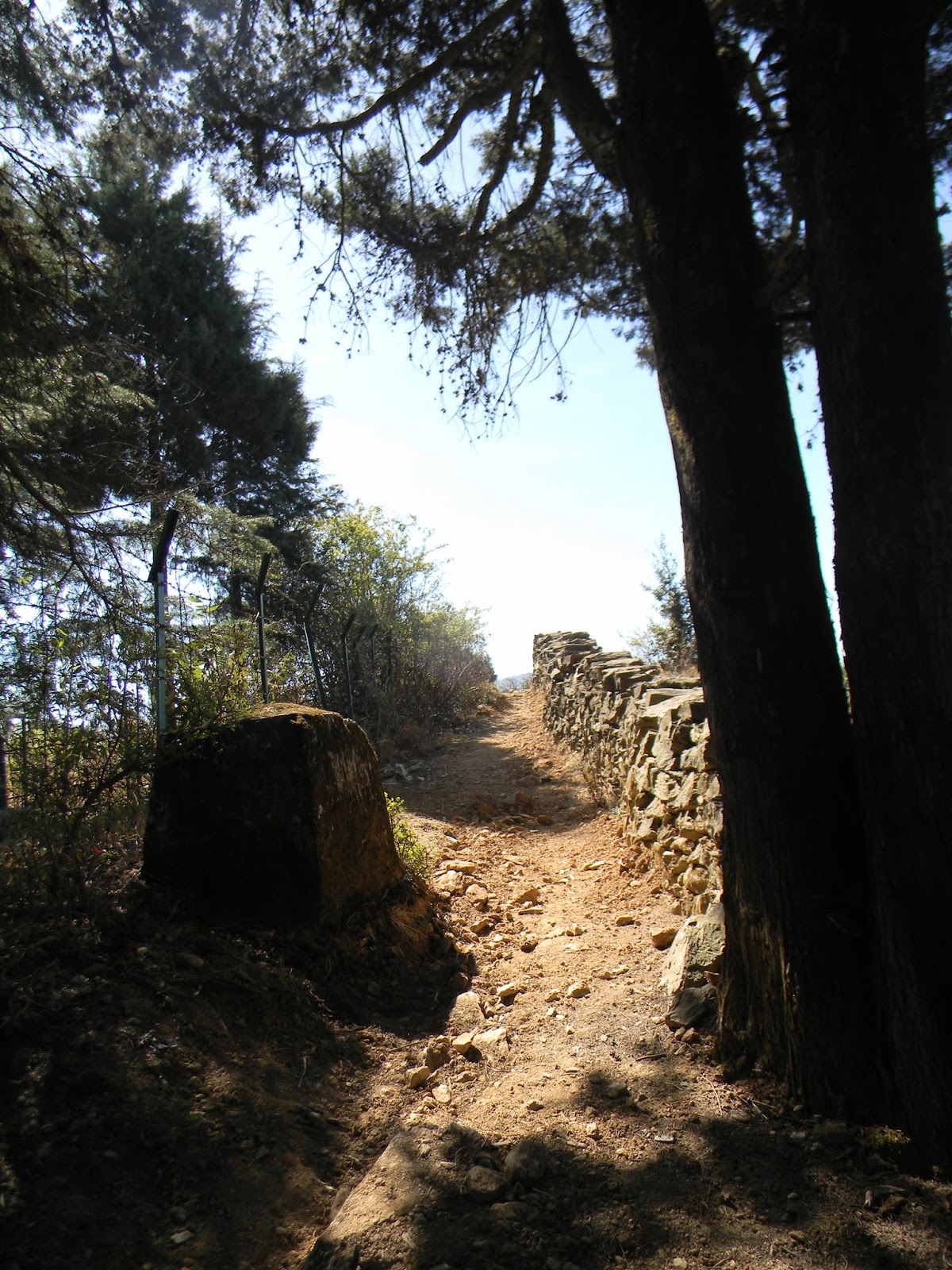
The paths around these parts...


The Chamba sky. Clear. Blue. Sparkling.


Counting life's blessings ;)


Red red sky just before dusk


The house glows like embers in the dark...


Father-daughter. Ruhee and Chanakya bhindo.


Zaara finds herself friends and spends her Holi with them


Holi Hai!!!!!!!


Zaara, Arjun and Piu


Zaara and Ruhee. Holi girls.


The caretaker, spinner of tales, Unniyal ji.


As the day comes to an end, Zaara sits and watches cartoon on TV...


This is near Dhanaulti. Dhanaulti is just one hour from Badshahi Sthall.


Roshmi ba and I, too happy with the hills, too happy to pose :) 

Ustad Iqbal Ahmed Khan, Khalifa of Dilli Gharana (Deccan Herald, 20 March 2016)

Nurturer of music
JUANITA KAKOTY, MARCH 20, 2016
AA
custodian of Dilli gharana Ustad Iqbal Ahmed Khan
I’ve been god-fearing from the beginning. And I am grateful to him that I have been lucky,” is the first thing Ustad Iqbal Ahmed Khan says, sitting in the small room of what constitutes the Ameer Khusro Institute of Dilli Gharana on Ansari Road in Old Delhi. The classical vocalist wears, as usual, a sherwani.


From the walls of the room, the giants of Dilli Gharana, who are framed in photographs, look at us. Pointing at a photo, he says, "That’s my guru and father Ustad Chand Khan Sahab. He didn’t have a son, so he adopted me.” In another photo are his father-in-law, Ustad Hilal Ahmed Khan, and his biological father, Ustad Zahoor Ahmed Khan, "sons of Ustad Chand Khan’s younger brothers.”

Few are as blessed as this singer who was born in the lap of music and into a family that has defined Indian classical music for centuries. But, as he says, although music is a legacy gifted to him, it did not come easily. "I have served not only music all these 60 years, but also my teachers, with whom I have spent most of my waking hours - responsive to their emotions as well as to the nuances of singing they have taught me.” He says his biggest support in life has been Zohra Khan, his wife, with whom he has grown up.

Mausiqui Manzil

Iqbal Ahmed Khan was born and brought up at Mausiqui Manzil, a 200-year-old building in Old Delhi, where he lives with his family now. "Artistes from all over the world came here to meet the then Khalifa of Dilli Gharana, Ustad Chand Khan Sahab. They either stayed with us or at the Haji Hotel in Jama Masjid.” He is the current Khalifa of the centuries-old Dilli Gharana of Indian classical music.

It’s here that he heard the great musicians of his time, and grew up with an understanding of the taans, surs and taals. "It was a privilege. In 1961, Bhai Lalji Lahorewale visited us. So we had a mehfil. He was one slim man, must have been 80 years old. But he sang effortlessly! Senior artiste Qadarbaksh Khan sang the bandish Nevar Ki Jhankar in Chhayanat raga for us. My father asked me to concentrate on how he rendered it. I still remember it.”

And, he continues with another anecdote: "One of the visitors was the legendary rudra veena exponent Ustad Sadiq Ali Khan. He didn’t stay with us, but at the hotel. When he visited us every evening, he saw me flying kites. He wondered, in front of my father, if I ever do riyaaz. My father asked him not to worry, and said that the little one’s mind was at the session. Khan sahab started playing and at one point, deliberately went off tune. I turned around immediately and looked at him, still holding the string of the kite, and started chanting, 'You have gone out of tune!’ I must have been 10 years then.”

Lesson to remember


Along with music, his ustad has also trained him in humility and kindness. "When I was 12, I was admonished for impertinence at a gathering in Jaipur. It was already evening when I sat down to sing. My guru went for his evening namaz. Senior musician Hidayatullah Khan, about 70 years old then, played the tabla with me. Somebody told me that he could make singers go out of rhythm. I took it as a challenge and started a bandish. At one point, I sang in a manner that made it impossible for him to keep pace with me. He began to cry. A child had humiliated him! My guru, back from the namaz, slapped me in front of everyone.'Have I taught you so that you can insult your seniors?’ he thundered, and then asked the senior musician to forgive me.” He chokes as he narrates this tale.

His tales also reveal that the training sessions were extremely rigorous. He remembers that he was made to go through only two ragas for the first 24 years of his life as a singer. Puriya at night and Komol Rishabh Asavari in the day. And, how much has he been able to pass on to his students? He unravels a secret, "There comes a wave in time when an ustad reveals, like an epiphany, some nuance that is otherwise often inexplicable. This wave doesn’t occur twice. I have been able to give to my students as much as they have been able to receive.”

Friday, 11 March 2016

On Diya Naidu's work in contemporary dance (Deccan Herald, 28 Feb 2016)

Steps in self-exploration

Juanita Kakoty, Feb 28, 2016
Contemporary moves
Dancer Diya Naidu


Dancer and choreographer Diya Naidu sees a performance as a combination of self-expression and messages carrying universal appeal. Juanita Kakoty in conversation with the young artiste...
Award-winning choreographer Diya Naidu defines her work as “movement and dance-based contemporary performance”, which, at the moment, might seem to take a socio-political turn, but has, and always will, she emphasises, “be layered by spiritual and existential questions, and research.”

Although she has been dancing ever since she was a little girl, Diya thinks “finding contemporary dance was for me the beginning of really becoming a movement artiste. I loved training in jazz and kathak, but there was something about martial arts that always attracted me. I found the diploma at Attakkalari Repertory Company and auditioned mainly to train consistently in kalaripayattu. Here is where my body found the vocabulary it needed to truly express itself, with all the nuances and layers that make up contemporary existence today.”

Keeping at it

Reflecting on how dance makes her find herself, Diya says, “My first solo choreography was perhaps when I was eight or nine years old on a captive crew — my little sister and cousins — whom I bullied into performing in my homemade production. This was followed by many pieces over the years on school and college teams. But my first piece as a contemporary choreographer was a 20-minute solo called Nadir. This was made under the auspices of The Robert Bosch Award for Young Choreographers.” 

She tells me that Nadir was based on the idea of ‘aloneness’ in the urban context and the schizophrenic experience of being ‘isolated’ in the existential sense and yet being surrounded by noise, chaos and the stimulus of the urban jungle. “It uses movement, dance as well as film. This piece was a collaborative experience for me. I worked intensely with filmmaker Nimish Jain, with Shymon Chelad for music and light design, with Elan studio for costume, and with the Teichmann brothers from Germany for sound. This was my first work which let me explore who I was — not just as a dancer, but as a choreographer, too. It was the seed that shaped the existential, spiritual and socio-political space I am seeking to investigate today as an artiste. It made me a better performer, taught me to conceptualise, and forced me to articulate, research and hold more conviction in my ideas. It was cathartic for me in an emotional sense as it allowed me to creatively resolve and navigate certain questions and issues of my own. It made me address many bad habits as a thinker and creator of work, and insecurities as a performer.”

Her other works like Bardo Beings and Red Dress Waali Ladki have been equally well-received. Diya points out how she draws from diverse realms. Trained in bharatnatyam, jazz, ballet, kathak, physical theatre and kalaripayattu, Diya had worked with the Attakkalari Repertory Company for seven years, where, she says, she trained in the contemporary South-Asian vocabulary that is unique to Attakkalari and its director, Jayachandran Palazhy. Diya has also trained in yoga, put herself into as many workshops as she could, including mime, training for actors, contemporary, modern and somatic practices, and biodynamic craniosacral therapy.

Talking of her technique, she says, “Earlier, my process was much more physical with a focus on dramatic presence, movement quality and physical stamina and rhythm. At the moment, though these are still important to me, I have begun to seek a more integrated performance approach involving equal engagement with voice and acting skills. This means that I am grappling with ways to accommodate all these aspects into my being with harmony, ease and consistency.”

Diya is working on Rehem, a duet between two women that addresses their impulse of just being who they are as human beings and alive, not reacting to historical and current baggage of who and how a woman should be. There are other pieces of work in progress — Labour of Love: around the idea that love and hate come from essentially the same space, and Today, Don’t Insist On Leaving, a duet created with an older actor around the theme of ageing and the elderly. 

Ways are many

And there is so much poetry in the way she explains how she conceives her work. “Sometimes a piece makes itself — motifs appear in dreams, a dancer/actor catches your fancy as muse, a book transports itself to the movement realm during a daydream on a train, a suggestion takes flight in one’s mind, a theme is proposed as commissioned work and yet becomes one’s own. There are many ways to dream, write, paint and dance. What seems essential is to find a personal resonance and yet tell a universal story; to be specific and yet somehow open a window to something beyond that minuscule implication. And, above all, to try and play, explore and keep at it till something makes sense in the way the artist dreamt it into being.”

Zaara’s video blog :)

My 7 year old daughter wants to start a video blog. I asked her what she wanted to do with it. She said, she would describe the books she l...