Tuesday, 30 August 2016

Spaces and people in Berlin and Munich. July 2016.

So finally I got to go to the city where Nadeem spent more than two years of his life. Berlin. Where our dear friend Monika lives. Where Zunnoon, the child Nadeem spent most of his time with while in Berlin, and has loved dearly, has grown up. And it proved to be as good as he always told me. In fact, once there, it didn't seem like it was my first time. I had the feeling of being there before. Strange, I know. But this is how I felt, like I knew its corners and bends and streets and buildings from before.

In Berlin and Munich I got to see some interesting places. And very inspiring too. Thanks to the Visitors Programme conducted by the Federal Foreign Office, Germany that I was a part of. Sharing a few pictures and stories from my trip.

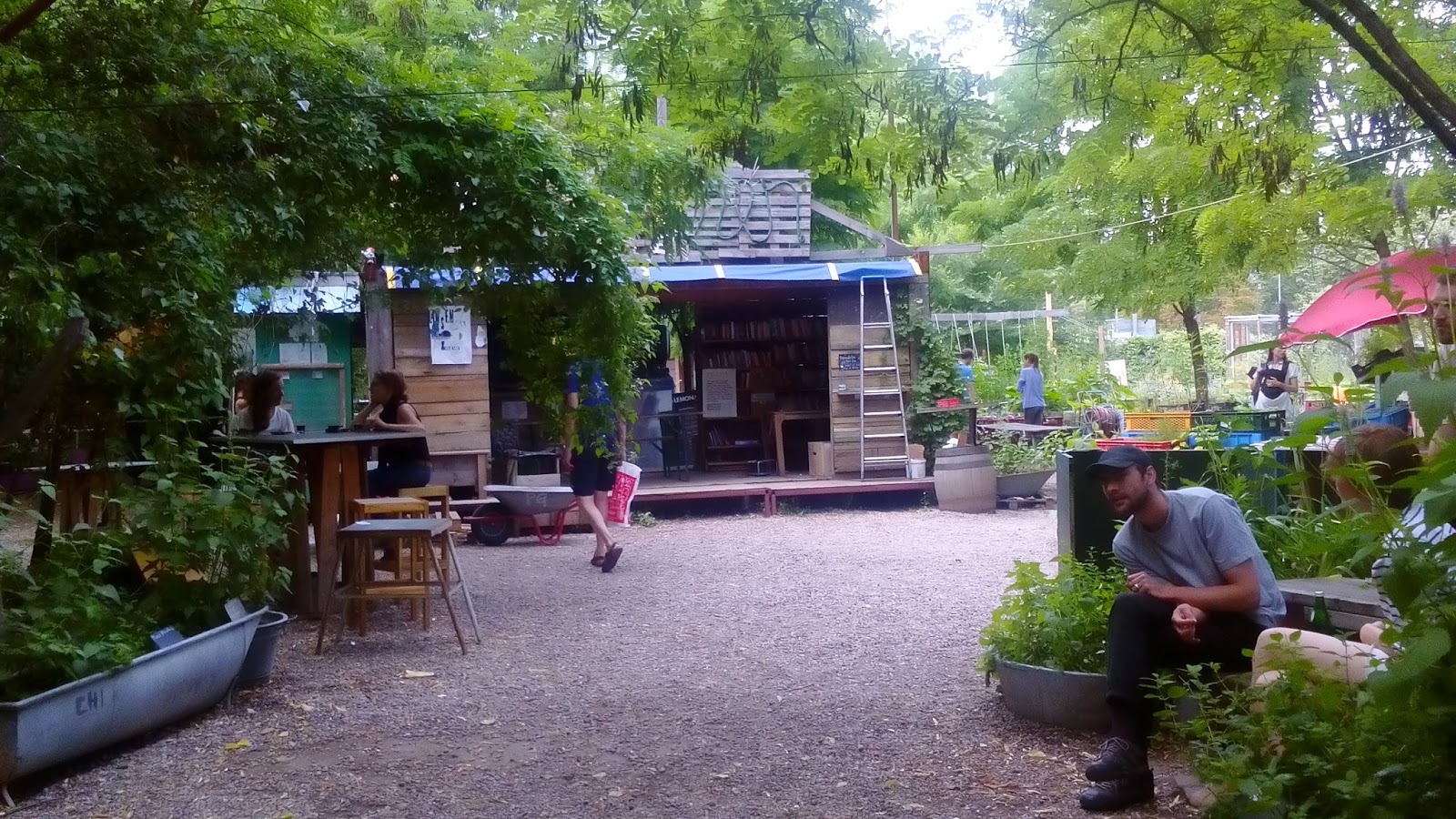
My kind of place. This is at the garden restaurant of the urban gardening project, Prinzessinnengarten (Princess Garden). This is a 6000 m2 area of wasteland near Moritzplatz, in the district of Kreuzberg, which was transformed into an ecological and social urban farm in 2009. It not only grows agricultural products, but has also become a space for a new kind of urban lifestyle where friends, neighbours and other interested parties can work, learn, rest and play together.

Garden restaurant, Prinzessinnengarten (Princess Garden)

With my colleagues from the programme at Prinzessinnengarten (Princess Garden)

Murals at Prinzessinnengarten (Princess Garden)   


This is at Agora Collective, a network and co-working space at Kopfstrasse that facilitates the encounter of ideas and resource development among people and projects. It has bright office spaces, large art studios, silent zones and an awesome cafe.

Young people at the co-working space, Agora Collective.

Now this is at Tempelhof, Berlin, which used to be one of the major World War II airports in the country. The airport ceased operating from 2008 amidst controversy. Now it is a huge open space where families come to picnic and a group of inspiring women negotiated with the government and are using a patch of land here for community gardening especially for refugees and middle class people to grow their own veggies, etc.  

Relaxing at Tempelhof community gardening site :) The interesting thing is, all plants and veggies at Templehof are grown over the ground in containers. Digging the ground is not allowed because there might be mines that would go off since it used to be an airfield during World War II. 

Hotel Piep for little friends with feathers :) Tempelhof.

At Tempelhof, they are growing anything anywhere! Old boots, mugs, footballs, shoes, etc.

The inspiring women who run the community project at Tempelhof.

View from the United Services Union office at Paula-Thiede-Ufer.

Welcoming refugees! Sight from the United Services Union office at Paula-Thiede-Ufer.

Now this is where I went for lunch one day. It used to be a hospital formerly where the Squatter's Movement started. Since then it has been transformed into a cultural space.

"The squatters’ movement that started in the late 1970s was motivated by concerns both political and personal. On the one hand, the movement attracted those who wished to protest the lack of affordable housing and the negative effects of postwar urban renewal. On the other hand, however, it also appealed to some young people who were primarily interested in escaping both parental control and the burden of paying rent."  (Source: GHDI http://germanhistorydocs.ghi-dc.org/sub_document.cfm?document_id=440)

There are beautiful sculptures all over Berlin and Munich. These two are near the Friedrichstraße station (railway station) in central Berlin (Berlin Mitte). 

A group photo with my colleagues from the programme at Brandenburg Gate.

"The Brandenburg Gate, a monumental gate built in the eighteenth century as a symbol of peace, is Berlin's most famous landmark. During the Cold War, when the gate was located right near the border between East and West Berlin, it became a symbol of a divided city." (Source: http://www.aviewoncities.com/berlin/brandenburgertor.htm) 

The Quadriga, Brandenburg Gate. 

The bronze quadriga of victory crowning the gate was created in 1793 by Johann Gottfried Schadow. The four-horse chariot is driven by the winged goddess of peace. 

"In 1806, when Berlin was occupied by French troops, Napoleon ordered the quadriga to be taken to Paris. After Napoleon's defeat at the Battle of Waterloo, the quadriga was triumphantly taken back to Berlin, and was turned into a symbol of victory: an iron cross and eagle were added to the laurel wreath. At the same time the square near the gate was renamed Pariser Platz and the statue on the quadriga was now called Victoria, after the Roman goddess of victory." (Source: http://www.aviewoncities.com/berlin/brandenburgertor.htm)

And then finally, I got to see where Nadeem lived while he was in Berlin. Thanks to Aunty (Monika's lovely mom) who drove us down to Wedding.

Aunty and I at Lynnarstrasse (in Wedding), where Nadeem lived. And where Hitler committed suicide with his wife of a few hours, but long time companion, Eva Braun.

Monika and I right in front of the building where Nadeem stayed for more than two years. So, you see, historically how important this trip has been for me :D :D 

Very close to the building is this fantastic place where Aunty treated us to the most amazing pizza I have ever had in my life and some awesome beer from the brewery the place owns! 


This is the Central rail station in Berlin

At Berlin Mitte, where I was staying, was this awesome Sushi Bar at rates much cheaper than anywhere in Delhi (for sushis). I loved the sushis as well as this young girl who had just arrived from Vietnam a couple of months ago and helped out her uncle at the restaurant. Her uncle had started this place long long ago. She wanted me to teach her English. So after the sushi and some great Berlin beer, I gave her a half an hour English class :D 

This is one evening when I went to spend some time with Monika. We walked up to her apartment at Kreuzberg, which is a cosmopolitan neighbourhood. She took me to a Vietnamese place somewhere nearby for great food :) The picture here was taken by me just as we were about to enter the area where she lives. Would anyone believe me if I said that this place was primarily constructed and still houses lower income group people?  

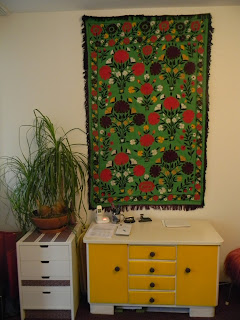
A corner in Monika's house. A beautiful handcrafted piece she had picked up, I think, from Afghanistan.

And here we see Monika's baby (the plant), resting in her bedroom, whom she has to give a wash every once in a while in the bathroom :D

And when Monika is not researching/teaching/presenting papers at Max Planck, this is what she does. Be out on the balcony, lounge and celebrate the gorgeous evening sky ;)

Now this is in Munich. At Marienplatz.
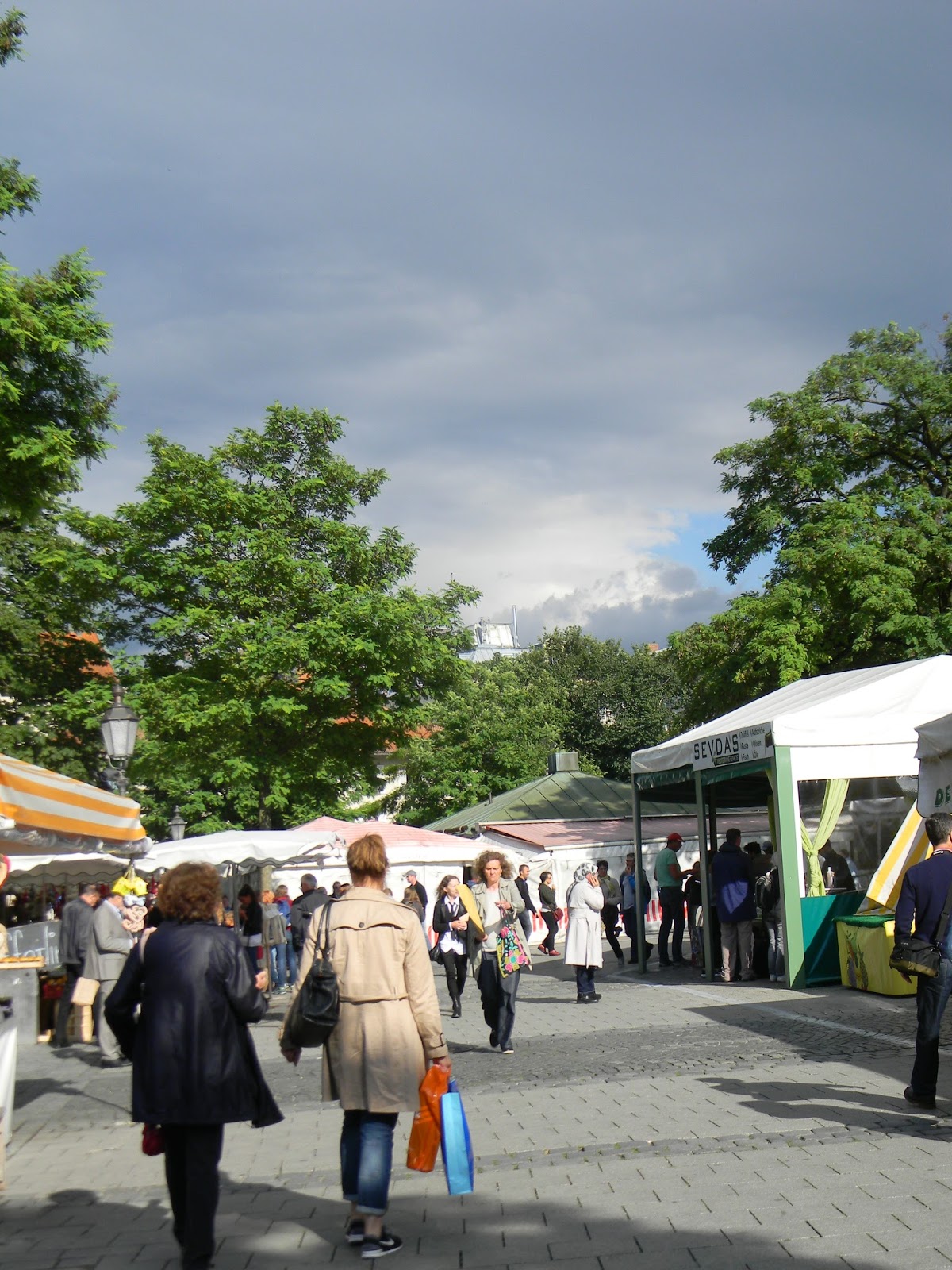
Marienplatz is a very old town centre, and is the heart of Munich.

A pretty shop at Mareinplatz

Interesting things one gets to see here.

Our guide was excellent. She took us through the main town centre, giving interesting history about the place.

She showed us this. A symbol that Hitler had put up on the tower of the Old Town Hall in Munich. After Hitler's death, this symbol was taken off. Interestingly, it is in Munich where Hitler had found supporters when he was starting out with his political ambitions. He founded his Nazi Party here.

A walk inside a mall at Marienplatz

The blue trams that charmed me in Munich :)

Wednesday, 10 August 2016

Addressing Trafficking, Prostitution and Vulnerabilities in India (published in Thomson Reuters Foundation, 10 August 2016)

Recently someone asked me how is inter-generational prostitution akin to trafficking. There is consent involved as girls grow up seeing their mothers and aunts in prostitution, and they are initiated into it by their own family. I was conducting a session on human trafficking with a group of Panchayati Raj Institution members from West Bengal, and one of them posed this question. For many who don't know that there is something like inter-generational prostitution, let me tell you that I work with this anti-sex trafficking organisation called Apne Aap Women Worldwide (www.apneaap.org) which works with prostituted, marginalised and at-risk of being trafficked women and girls from red light areas as well as certain caste communities in Delhi, Bihar and West Bengal in India which suffer from 'inter-generational prostitution'. That is, for these caste communities, 'inter-generational prostitution' is a form of livelihood. But, at Apne Aap, we look at it as a case of trafficking.

Read rest of the text at http://news.trust.org/item/20160810073430-k84bf/

Thursday, 21 July 2016

Meeting a 'sex-worker' and an abolitionist in Germany

I have met prostituted women and girls. The organisation I am with, Apne Aap Women Worldwide (www.apneaap.org), works with prostituted and at-risk of being trafficked women from certain caste communities in India where inter-generational prostitution exists. Our organisation also works with prostituted women and girls in red light areas, like Sonagachi - one of Asia's biggest red light areas. Our attempt is to bring these women and girls out of prostitution by offering them more choices in life through education and livelihood linkages. And we have seen how women come out of the system with help and when choices are available. Or for those who cannot come out, they insist that we do something for their girls so they don't live the lives of their mothers. In other words, the prostituted women my colleagues and I have met don't feel good about what they do. Don't hold a sense of pride in what they do. And definitely do not look at what they do as something that contributes to a dignified life, which is by the way a basic human right acknowledged globally.

So when I met this young Czechoslovakian woman (I am assuming she is Czechoslovakian by her name, which is a popular traditional name from the region which was a former country - Czechoslovakia) in Berlin last week, who identified herself as a 'sex worker', I had to listen to her because this was the first time I had met not a 'prostituted' woman but a 'sex worker'. She works with an organisation in the city which conducts peer-to-peer education for 'fellow sex workers', she said. She educates them on their rights, gives them tax advice (because prostitution became legal in Germany in 2002), health and hygiene advice, advice on how to treat good customers and bad customers, etc. This is indeed important work, I must admit, for most of the women she is talking about come from a background where these discussions aren't happening. Also, most of them are from East European countries and therefore they all the more lack knowledge about the legislation in Germany.

The young Czechoslovakian woman, pale with a sad look in her eyes, asked me why we want to criminalize the pimps, the brothel owners and the customers. 'Why do you want to rob us off our work?' she asked me. She sat there looking accusingly at me with those enormous sad eyes in a beautiful office. On the other couch sat an elderly woman, affectionate, quiet and there was something very powerful about her presence. I must admit I liked both of these women. Independent women, powerful with their voice, but just that I hoped they used their voice for something that wasn't as short-sighted as asking for keeping the prostitution cycle going rather than wiping it off totally.

So the young Czechoslovakian woman, with bruises (maybe love bites, but ugly ones) on her arms, asked me why are we campaigning for the Nordic model (which decriminalizes the prostituted woman but criminalizes and penalizes the pimps, brothel keepers and customers). As a response, I asked her why wouldn't she and her colleagues do that? She gave me a long answer, which I believe just proved my point. I don't know if she sensed that.

She told me that women like her who find themselves in poverty, no education and skills to opt for other livelihoods, choose 'sex work' because that brings them out of poverty. She said that all those who speak for abolishing 'sex work' are moralists. I told her it is not a question of morality but violence and abuse in the name of work. I asked her if, just because prostitution is legal in Germany, she had not ever come across a customer who made her behave like a sex slave. She said there were customers like this, but that she also had good customers who were tender with her. But what caught my attention was, in a country where prostitution is legal, the so-called 'sex worker' had rights, she could also be made to act like a 'slave'. I only wished her words were ringing in her ears in the same tone as they were in mine.

I asked her why wasn't she and her colleagues simultaneously campaigning to pressure the government to invest more on women and girls from the kind of background that they come from, so they can have better choices. To this, she said, and her older colleague joined in, that the state is too patriarchal and so is society, which is why, from what I gathered, they have not much hope about seeing a world where there is no prostitution.

Anyway, when I was leaving, she came running down the stairs to give me some literature. We lingered at the door for a few moments. 'Why did you come?' she asked me. 'Think of me as a fellow woman,' I said, 'Not as someone from an organisation or a campaign.' There was a lot of warmth in her hug. And as I left, I carried her sad eyes with me.

***

With abolitionist Inge Kleine at the KOFRA office in Munich

In Munich, I met an abolitionist. At the pleasant and warm KOFRA office, a few women were browsing through books as Inge Kleine and I sat at a table discussing the young abolitionist movement in Germany and prostitution over some nice coffee. She told me that the Czechoslovakian woman I met in Berlin was from an organisation that received funds from the government. Anyway, what seemed striking to me is the recent developments in the country. A small abolitionist group which is now slowly increasing in strength. A few members from the Bundestag I met in Colombo and in Berlin, who were willing to listen to me when I spoke about the Apne Aap experience in India. They were all willing to engage with Devaki Jain and Amartya Sen's notion of how development ought to be especially in South Asia: focused on rights rather than needs because with persistent lack of something, a community ceases to regard that something as a need. So, persistent lack of education makes a few communities think of schooling for children as a luxury. Persistent lack of healthcare makes a community regard healthcare as luxury. Persistent lack of housing makes a community perceive housing as a luxury. All these are basic human rights, respected by constitutions across the world as well as the United Nations human rights declarations, but the communities in question cease to see them as needs.

My experience with the young Czechoslovakian woman brought me to the same conclusion. She and her colleagues come from a community where the human right to dignity (receiving proper respect from others and treating oneself with self-respect) was perhaps not seen as a need. She spoke to me about her right to work in whichever fashion she wanted. She spoke to me about her right to seek state benefits. But she never for once spoke about her right to be treated with respect, but blamed the lack of this to patriarchy. And this brings me to my next point: the constitutional law of the Federal Republic of Germany has at its core human rights and human dignity. And if this has not assured human dignity to the prostituted women, some of whom may call themselves 'sex workers', then there must be something severely wrong either with people or with prostitution. For as we understand at Apne Aap through years of working with prostituted women, a woman never prostitutes herself. It is other people or the circumstances that prostitute her. In other words, prostitute has to be understood as a verb and not a noun if we want to engage with the notion of human dignity.

Inge Kleine at the KOFRA office in Munich. KOFRA (a communication centre for women) is a woman's initiative. Inge runs the Abolish Prostitution Now page on Facebook (https://www.facebook.com/abolishprostitutionnow/?fref=nf).


Sunday, 5 June 2016

Who to decide how many children a woman should have?

I look after publications at Apne Aap Women Worldwide (www.apneaap.org); but because I like to engage with people, every once in a while I go to our field at Najafgarh - where we work with a few freed/denotified tribe (DNT) communities who earn their livelihood as snake charmers, drum beaters, rag pickers, and a few who are trapped in inter-generational prostitution - as well as to the primary government school our organisation  has adopted in the area and conduct open mike sessions. That is interactions in a group where everybody is encouraged to speak on a topic, trying to draw out their opinions and ideas basically. So the topic could be anything that might be relevant to them. Like 'child marriage' (because this is the practice in these communities), the 'benefits of caste certificates' (because they are amongst the most marginalized and poor communities in the country who often fall under the Scheduled Caste or Scheduled Tribe category, but are not aware of it, do not have caste certificates and even if they did they wouldn't know what to do with these certificates).

At the open mike session in the community at Najafgarh recently
                               
Now the last time I visited the community, I thought let the open mike today be on the right of a woman to decide how many children she wants. And I had put quite a lot of thought behind this. In these communities, you will notice very young girls as mothers. It is very difficult to say if the girl is over 18 years of age because many do not know how old they are and they do not have birth certificates to prove their age. So there would always be this young girl, still looking like an adolescent, with a baby clinging to her breast, and one or two more hanging by her kurta. They know that I have a four year old daughter, many of them have met her. And they now tell me that it's time I plan my second baby. There's nothing wrong in that. Many people, especially women, have told me on buses, trains and aeroplanes that I should now plan a second baby before it was too late and I regretted for life. And it often came from complete strangers too. Nobody understood or accepted when I said I don't want a second baby. They would all look at me as if I am morally wrong in that and get into a long lecture on what injustice it would be to my daughter who would grow up without a sibling. When I tell them that I am teaching my daughter to form lasting bonds with people in her life, and also teaching her to choose and keep the relationships she wants to keep, I get blank stares. That's not how you talk to a four year old, they tell me.

Anyway, so the last time I visited the community, and I saw this frail young girl who has become a mother for the third time, my heart just bled. Motherhood, from experience, is a lot of hard work as much as enjoyment. But the enjoyment associated with it will go down if the experience becomes frustrating for the mother. So here you are, not able to provide food for your family, but you go on and give birth to a third child when there are already so many mouths to feed in that joint family! So as we all sat down together, I declared that I am very proud of my daughter who loves me a lot and has brought me such joy, but that I choose to not go for any more children. All of them gave me that look. That I was wrong. Next I said, with the resources that I have - money, time, energy - I can give only one child the kind of life I want to gift her. If any more child comes in at this stage, it will disturb the balance. It was then that I saw how the look in their eyes shifted. Like they understood. And then of course I told them that no one can dictate how many children a woman can have. It is her right and her decision entirely. My right, your right.

I am glad Kari Egge, a leader with the United Nations for over twenty years, and currently the founder of Half the World (that trains women to assume leadership roles at all levels), was with us during this visit. She told them that she was in her sixties, traveled the world, no one told her what to do with her life, when to do what, and that she has a 19 year old bright daughter who goes to college. A young woman with a 19 year old daughter looked at her with eyes wide open. And then the women spoke. They spoke about the dreams they have for their daughters and sons. And the daughters spoke of their own dreams. They want to become teachers, dancers, social workers. And the mothers expressed that their daughters shouldn't become mothers at an early age. But they also expressed the fear that it might be tough to fight the society when it comes to taking such decisions.

When Kari, in her sixties, told the women that she has just one child - a 19 year old daughter, the look in their eyes changed. 
                         
We can only hope that the conversations they have with us will one day teach them the strength to fight such customs and ideas. Like how conversations have taught me and Kari and so many other women who choose to live life on our own terms. Here I remember what Rachel Moran, prostitution survivor who played an important role in getting fair anti sex trafficking laws passed in her country Ireland (which decriminalizes the prostituted woman but criminalizes the pimp and customers), once told me. When as a teenager she found herself prostituted, for years after that she didn't know how to get out of it although she wanted to, because she wasn't having the kind of conversations that would tell her which was the way out. Likewise, at Najafgarh, we hope, that with the conversations the women are having with us, there will come a time when they will not only see the way out, but also learn to be strong to pursue empowered lives.

Friday, 3 June 2016

On the Road. Colombo.

Almost a month later, comes this second part of my blog post on Colombo. These pictures were taken at random, mostly on the road. And as I mentioned in my earlier post, I was charmed by Colombo, by how clean its roads are, by simply how beautiful the city is.

This is at Galle Face. By the Indian Ocean.

Enjoying her evening with  her grandchildren.

Sri Lankan autorickshaws. Very colourful.

The city is dotted with such vans selling food and vegetables and what not.


There are pretty colonial buildings as such all over.

Monk and Rooster. At Gangaramaya Temple.

See how happy somebody is to see me!!!! :D

And this is for real. At Gangaramaya Temple.

Buddha and the Bodhi Tree. Gangaramaya Temple.

Shaikh Usman Waliyullah Shrine and Masjid

This is just a park by the road. It's like the road extends into the park... and vice versa.

A winged friend by the road

On the road

Somewhere close to Galle Face.

The city from my window at Lakeside Cinnamon.

A relaxed afternoon. At Lakeside Cinnamon. 

Zaara’s video blog :)

My 7 year old daughter wants to start a video blog. I asked her what she wanted to do with it. She said, she would describe the books she l...